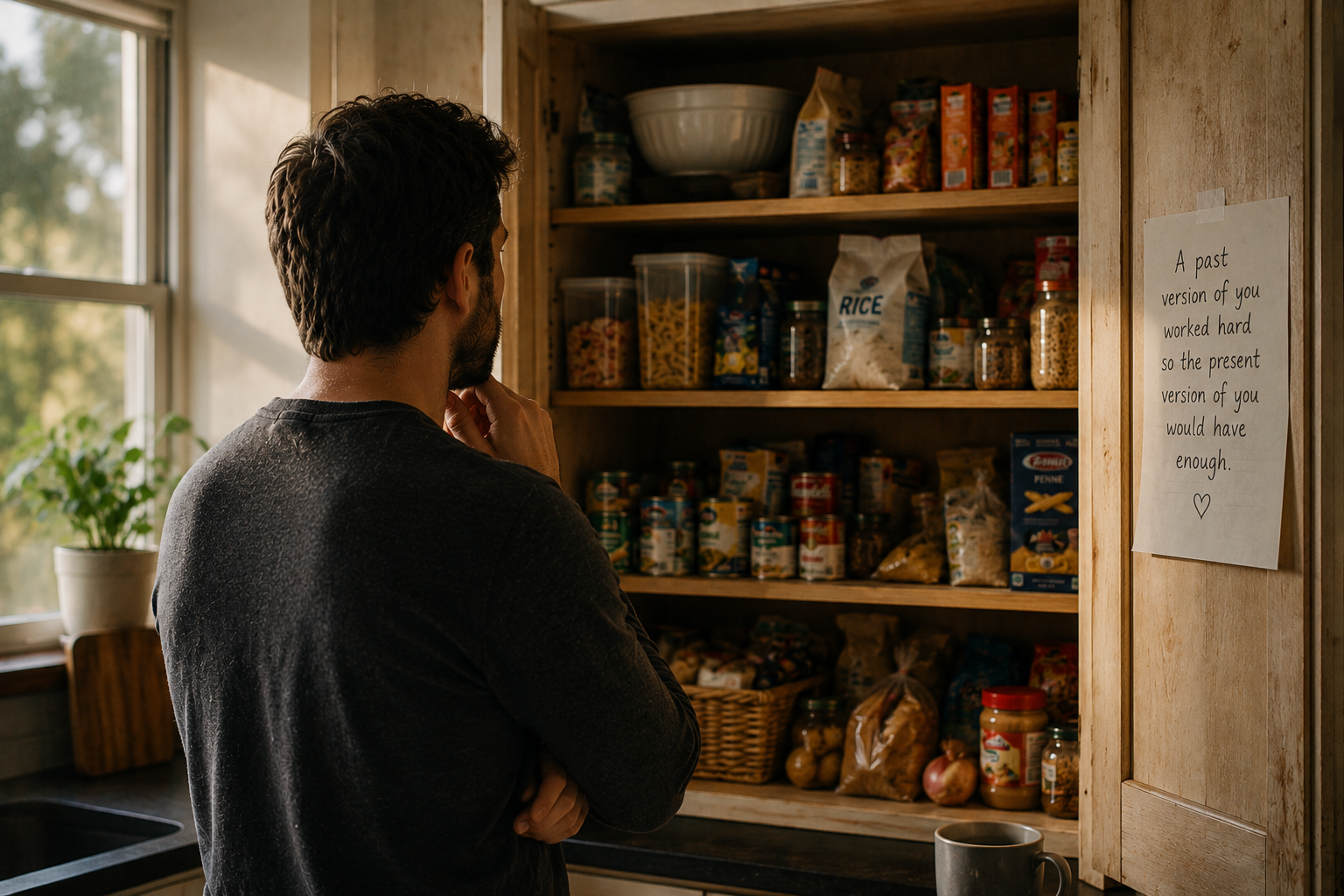
The month I challenged myself to shop from my own cupboards changed the way I think about money.
For weeks afterward, I walked through my house noticing something I had never paid attention to before.
I wasn't seeing things I owned.
I was seeing future savings.
The can of soup in the pantry. The detergent under the sink. The furnace filter in the basement. The lightbulbs in the closet. The extra batteries tucked away in a drawer.
Each one represented money I wouldn't have to spend later.
Then I realized something else.
Buying something doesn't create savings on its own. Using it does. Every item that gets used is one less purchase a future payday has to make.
Once I noticed it, I couldn't stop.
Most of us think a payday is over when the money leaves our bank account.
I've come to believe that's when a paycheck starts doing its real work.
Your paycheck doesn't disappear.
It changes shape.
A paycheck becomes groceries. Those groceries become dinners. Another paycheck becomes winter boots that keep your feet warm on a freezing morning. Another becomes laundry soap, toothpaste, a full tank of gas, or a stocked medicine cabinet. Before long, much of your income isn't sitting in your bank account anymore. It's working quietly all around you.
That's easy to overlook because we rarely stop to think about it.
I don't walk through my home wondering what everything cost.
I think about the ordinary Fridays that paid for it.
One payday bought the vacuum. Another filled the pantry. Another replaced the tires. Another bought the coffee maker that's used every morning. Another paid for the couch where we end the day.
None of those purchases felt especially important when I made them.
Together, they built a life.
Personal finance usually encourages us to focus on what's next: the next payday, the next raise, the next financial goal. Those things matter.
But if we're always looking ahead, it's easy to miss what yesterday's paychecks have already built.
Take a slow look around your home.
Almost everything within reach exists because a past version of you got up, went to work, earned a paycheck, and decided it was worth bringing home.
That's where gratitude and personal finance meet.
Gratitude helps us recognize what we've already built. Good financial habits help us build even more. One reminds us to appreciate today's life. The other helps create tomorrow's.
I'll always look forward to payday.
But I don't see it as a finish line anymore.
I see it as another opportunity to make a future day a little easier, even if I don't know what that day will bring.
A full pantry.
A warm house.
A reliable car.
Clean towels.
Food in the refrigerator.
Working smoke detectors.
None of those things appeared overnight.
They were built one payday at a time.
Most of us receive only about 1,040 paydays during our working lives.
Look around.
You're already living inside many of them.