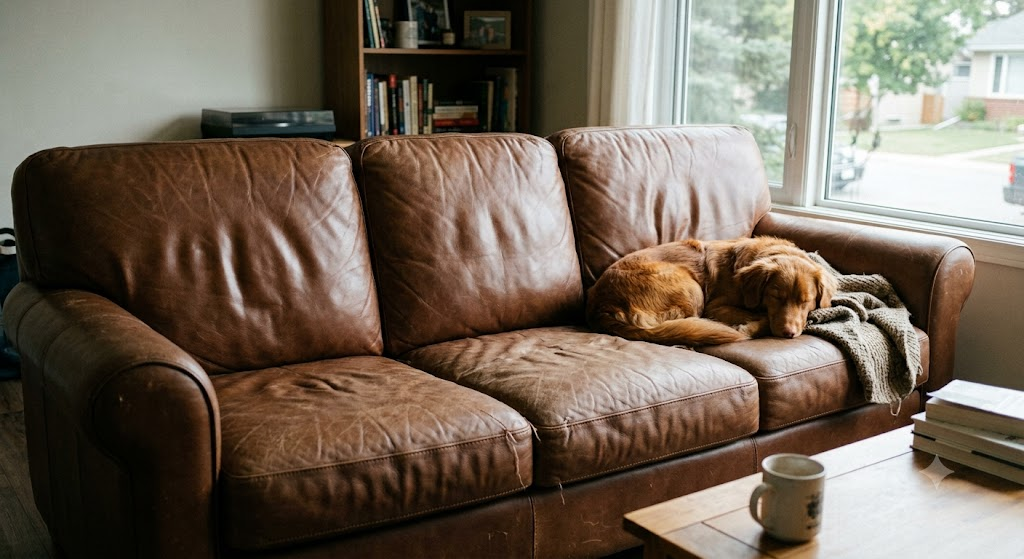
Let me tell you about my sofa
Before this sofa, I owned a big, fluffy brown fabric one that I bought at a garage sale.
It had already seen plenty of life before it came home with me, and it saw plenty more afterward. It moved with me, held friends during hockey games and survived late nights, lazy Sundays and more than a few takeout meals.
Eventually I sold it, but not because it had stopped being useful. It was enormous, I needed the space and someone else was happy to give it another home.
That sofa did exactly what a sofa is supposed to do. It gave people a comfortable place to sit for far longer than anyone probably expected.
The sofa I have now
The leather sofa in my living room today was not the most expensive one in the store, and it certainly is not the nicest leather sofa available now.
It has loose threads. The leather has softened and wrinkled after years of movie nights, afternoon naps and ordinary family life.
My dog has claimed the corner beside the window. The cushion beneath him has a permanent dent from the countless hours he has spent there watching people pass the house.
Someone else might look at it and decide it is time to shop.
I look at it and think it is still a very comfortable place to sit.
My sofa isn't worn out.It simply looks like people have lived here.
When normal wear starts looking wrong
Somewhere along the way, many of us began treating normal wear as evidence that something needs replacing.
A wrinkle appears in the leather. A scratch marks the dining table. A finish is no longer fashionable.
None of those things changes what the furniture was built to do.
The trouble usually begins when we compare it with something newer. A renovation show announces that brown furniture is dated. A magazine introduces another decorating trend. Social media serves up living rooms that look as though nobody has ever eaten, slept, spilled anything or owned a dog.
Soon, the furniture in your own home begins to look worse even though nothing about it has changed.
The furniture stayed the same. The standard moved.
New does not stay new for long
I understand why new furniture is tempting.
You picture how it will look in the room. You imagine the cleaner lines, the untouched cushions and the feeling that the entire space has somehow improved.
Then people begin living with it.
The dog finds his corner. Someone spills coffee. The cushions soften and the leather creases.
Before long, the beautiful new sofa becomes what every sofa eventually becomes: the place where your family sits.
The excitement fades much faster than the payment plan.
Furniture was supposed to show its age
Furniture used to be purchased with the expectation that it would last.
A dining table collected scratches from decades of family meals. A rocking chair stayed in the same corner for years. A dresser moved from one generation to the next.
Those marks were not treated as design failures. They were evidence that the furniture had been useful.
Today, even a small sign of age can become an excuse to replace something that still works perfectly well.
There is a difference between furniture that is deteriorating and furniture that no longer looks untouched.
When I will replace it
My sofa will not last forever.
One day the springs may give up. The frame might crack. The leather could wear through badly enough that repairing it no longer makes sense.
When that day comes, I will replace it.
But a wrinkle is not structural damage. A loose thread is not a broken frame. A dent made by a sleepy dog is not a financial emergency.
The sofa can stay until it finishes doing the job I bought it to do.
The money can do something else
Replacing a perfectly usable sofa could cost several thousand dollars.
That money has other options.
It could reduce the mortgage, grow in an investment account, pay for a family trip or remain available for the day something in the house actually breaks.
Keeping the sofa does not feel like a sacrifice to me. I still have a comfortable place to sit, my dog still has his window and the money stays where it can serve a more important purpose.
There is a quiet satisfaction in realizing that something does not need to be replaced simply because you can afford to replace it.
My sofa isn't broken
The next time something in your home starts looking old, it may be worth asking what has actually changed.
Is it damaged?
Does it no longer work?
Is it uncomfortable, unsafe or beyond repair?
Or have you simply seen enough newer versions that the one you own has started to feel inadequate?
My sofa has wrinkles, loose threads and a cushion shaped around a small dog.
It also gives us somewhere to sit every day.
That is not a broken sofa.
That is a sofa doing its job.