Most people think the hardest part is saving the money.
I think the harder part begins after you've saved it.
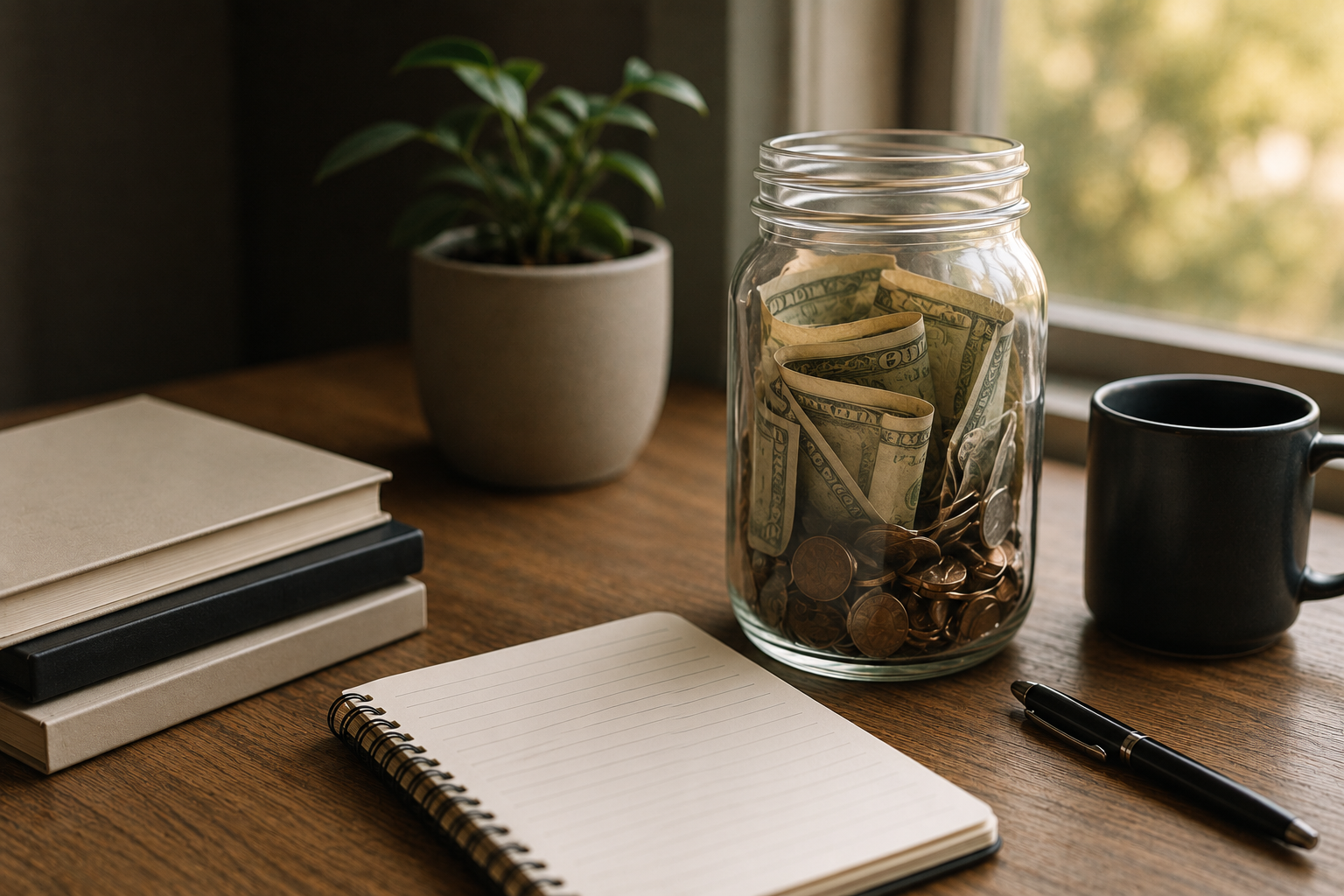
Saving your first $10,000 isn't something that happens by accident.
It's the result of hundreds of small decisions that nobody else sees.
Bringing lunch from home instead of buying it.
Waiting until the next payday before replacing something that could last a little longer.
Choosing the store brand.
Saying "not this time" more often than "why not?"
Putting a little aside from every payday, even when there wasn't much left.
None of those decisions feels life-changing.
Most of them feel forgettable.
But over time, they begin to add up.
Then one day you open your banking app.
There it is.
$10,000.
For a moment, it's hard not to smile.
You did it.
You proved to yourself that you could set a goal and stick with it.
For many people, it's the largest amount of money they've ever saved.
It represents more than a number.
It represents discipline.
It represents patience.
It represents choices nobody applauded while you were making them.
Then something interesting happens.
The money starts to look different.
Not because anything about your life has changed.
Because your mind has.
When your savings account held a few hundred dollars, it felt untouchable. It wasn't enough to solve many problems, so leaving it alone was relatively easy.
Ten thousand dollars feels different.
Suddenly it looks useful.
The vacation you've been talking about seems possible.
The car you've been driving doesn't feel quite as reliable as it did a month ago.
The deck in the backyard starts looking like a project you could finally afford.
None of those thoughts makes you irresponsible.
They're completely normal.
Once money becomes available, our brains naturally begin assigning jobs to it.
The challenge is that those jobs aren't always the ones we originally had in mind.
That's why I don't think saving $10,000 is the finish line.
I think it's the beginning of a different challenge.
The challenge isn't building the money anymore.
It's protecting the reason you built it in the first place.
Give Your Savings a Purpose
Reaching $10,000 changes the conversation.
Until then, your goal is simple: save.
Once you get there, the question changes.
Now what?
The answer depends on why you saved the money in the first place.
If it's your emergency fund, then it's already doing its job. An emergency fund isn't there to make you rich. It's there to keep a setback from becoming a financial crisis.
If you're saving for a down payment, every dollar already belongs to your future home. Spending that money today doesn't just buy something else — it pushes your goal a little farther away.
Purpose changes temptation.
Money without a purpose is much easier to spend because almost anything can seem like a good reason.
But what if you honestly don't know what the money is for yet?
That's okay.
Not every financial decision has to be made immediately.
In fact, taking your time is often the better decision.
If you're still deciding, consider moving the money into a separate high-yield savings account.
A high-yield savings account is simply a savings account that typically pays a higher rate than a traditional savings account while keeping your money accessible when you need it.
It's not meant to replace long-term investing, but it's a practical place to keep money that's waiting for its next purpose.
More importantly, it creates a little separation.
Money sitting in your checking account feels like part of your spending money.
Money that's been intentionally moved somewhere else feels like savings.
That small change can make a surprisingly big difference.
Think about a bag of leftover Halloween candy sitting in the cupboard.
Almost nobody decides to eat the whole bag.
You have one piece after dinner.
Another while you're watching television.
A few more over the weekend.
Before long, the bag is gone.
Savings often disappear the same way.
Not through one reckless purchase, but through dozens of small, reasonable ones.
A pizza night.
A sale that seemed too good to pass up.
A few things added to an online order because you were already paying for shipping.
A weekend away.
None of those purchases is likely to ruin your finances.
The danger is that they slowly replace the goal you were saving for.
You were intentional when you built that $10,000.
Be just as intentional about protecting it.
Money is usually saved one decision at a time.
It can also be spent one decision at a time.
The habits that helped you build your savings are the same habits that will keep it there until you truly need it.
The Question That Changed Everything
Looking back, the biggest change in my finances wasn't the day my savings reached $10,000.
It was the day I stopped looking at that money as something I could spend.
I started looking at it as something that was protecting part of my future.
That may sound like a small change, but it reshaped the way I made financial decisions.
Instead of asking myself, "What could I buy with this?"
I started asking, "What is this money protecting?"
Sometimes it was protecting me from an unexpected expense.
Sometimes it was protecting the dream of owning a home.
Sometimes it was protecting opportunities that hadn't even appeared yet.
Once I knew what the money was protecting, spending it became a much bigger decision.
Buying something wasn't just spending money anymore.
It meant giving up a little of the future I'd been working toward.
That doesn't mean savings should never be used.
Quite the opposite.
Money is meant to be used.
Emergency funds are meant for emergencies.
Down payments are meant to buy homes.
Vacation savings are meant to pay for vacations.
The goal isn't to save money forever.
The goal is to use it for the purpose you intended.
That's why I believe saving isn't really about building a balance.
It's about building options.
It's about giving your future self choices you don't have today.
And those choices aren't created by one big financial decision.
They're created by hundreds of ordinary ones.
One payday.
One transfer.
One decision to wait.
One decision to stay focused.
Saving your first $10,000 is an achievement.
Keeping it focused on the reason you saved it is an even bigger one.
Most of us will receive only about 1,040 paydays during our working lives.
Every one of those paydays is an opportunity to strengthen your future.
You built your savings one payday at a time.
Protect it the same way.
Make every payday count.