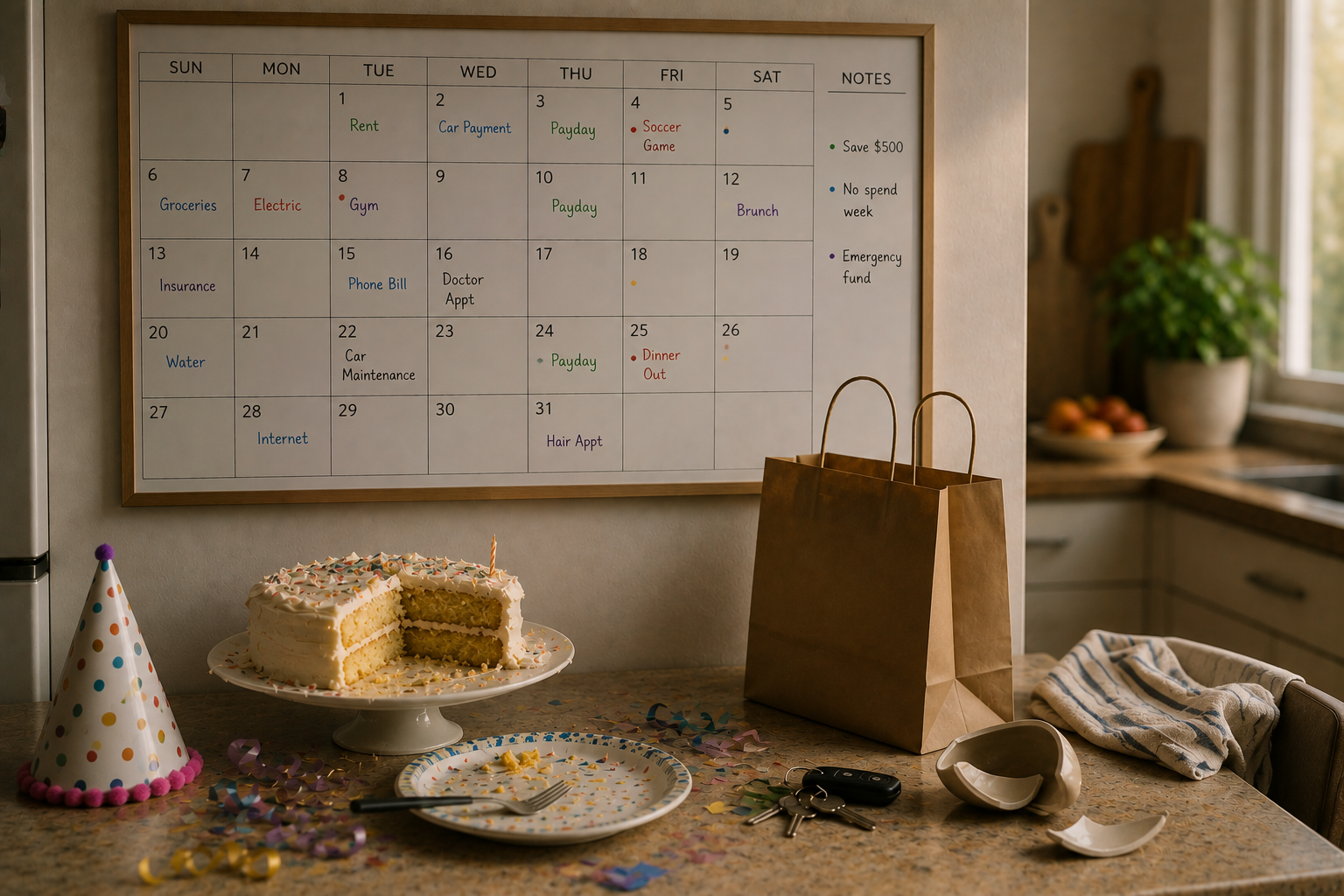
Most budgets assume your life will follow the calendar. Your money has other plans.
You can list every bill, set sensible limits, move money into savings, and check the numbers before you spend. Then one ordinary week rearranges the whole plan.
Work runs late, so dinner comes from a takeout counter. A birthday invitation appears in a child’s backpack. A friend lands in the hospital, which means parking, flowers, and a drive across town. The car starts making a noise that was not there yesterday.
Nothing extravagant happened. Nobody lost control. The month simply stopped looking like the version you planned.
That is when a budget can begin to feel less like a tool and more like a verdict. The categories turn red. The totals no longer line up. The app shows what changed, but it does not answer the question that matters now:
What should I do next?
Maybe budgeting feels hard because most systems are built to describe a month, while real people have to make decisions one day at a time.
The calendar is useful. It is not your financial life.
Most personal budgets begin with a month: monthly income, monthly bills, monthly savings goals, monthly spending limits. At the end, you compare what happened with what you expected.
That structure makes sense. Rent and mortgages are often monthly. Statements and reports are monthly. For a household with steady income, a large cash cushion, and predictable expenses, a monthly view can work beautifully.
But a household does not receive all of its money on the first day and make every decision at once. Paychecks land on their own schedule. Bills arrive on different days. Some costs are known but irregular. Others appear without warning.
Only about one in ten U.S. private workplaces pays employees monthly, according to the Bureau of Labor Statistics. Yet most budgets are still built around the month.
The monthly total may say you can afford everything. Timing can still leave you short on Tuesday.
That is not a math problem. It is a cash-flow problem.
A monthly budget takes a wide picture. Life happens in close-up.
Jen had a plan. Then Friday happened.
Jen and her partner are not careless with money. They have two incomes, a mortgage, children, savings, and goals they are slowly working toward. They know what they earn. They know what the major bills cost. They talk before making larger purchases.
Jen gets paid on Friday. Before the deposit arrives, she has already assigned most of it. Part will cover the mortgage. Part will stay in the account for utilities. Some will go to groceries, savings, and a credit card they want to clear before the holidays.
Then she works late.
By the time she leaves, everyone is hungry and there is nothing quick at home. She picks up dinner. It is not reckless. It was simply not in the plan.
The next morning, one of the kids brings home a birthday invitation. The party is next weekend. Jen adds a present and a card to the list.
That afternoon, a friend is admitted to the hospital. In the gift shop, Jen stands holding a $24 bouquet and wonders whether buying it means reducing the credit card payment. She buys the flowers. Arriving empty-handed feels wrong.
On Sunday, the car begins to make a grinding sound. The mechanic can look at it Tuesday. Until then, Jen does not know whether the repair will cost $150 or $1,500.
Her original budget is no longer the point. She now has decisions to make.
Does she move less to savings? Lower the extra credit card payment? Pay part of a bill now and the rest from the next paycheck? Keep her unexpected overtime for the car?
These choices are not evidence that the budget failed. They are the work of managing money.
A budget is not a prediction.It is a series of decisions.
Tracking is not the same as guidance.
Budgeting tools are often excellent at showing what already happened. They sort transactions, track categories, compare totals, and build charts. That information can expose a forgotten subscription, show that groceries have climbed, or make a long-term goal easier to measure.
The trouble begins when tracking is mistaken for guidance.
A pie chart can tell Jen that she spent more than planned on food. It cannot tell her whether buying dinner after a late shift was a poor choice, a reasonable tradeoff, or the only choice that made sense that night.
A red category can show that gifts exceeded the target. It cannot understand why she bought flowers for a friend in the hospital.
When a tool treats every change as a failure, the person using it can start to feel like the failure too.
But money is not a test of obedience. Sometimes the smartest financial decision is not the one you planned two weeks ago. New information arrived. Your priorities changed. A useful system should help you respond without pretending the original plan was sacred.
The important questions rarely wait for month-end.
Most people do not check their account because they want a historical report. They check because a decision is waiting.
Can we pay this bill in full, or would a partial payment protect the account until Friday?
Should an unexpected bonus go to debt, savings, or the repair we have delayed?
If we use savings today, what needs to change over the next two paychecks to rebuild it?
The tax refund came in. How much should solve a current problem, and how much should protect us from the next one?
These questions are not limited to people living paycheck to paycheck. A higher income gives you more room, but it does not remove tradeoffs. People with comfortable salaries still decide whether to spend, save, delay, divide, or redirect money. The numbers change. The need to choose does not.
For one household, an unplanned dinner means moving $40 from entertainment. For another, it means an overdraft. Both need a system that shows the decision before the damage, not only the transaction after it.
Flexibility is not permission. It is visibility.
A flexible budget does not pretend money is unlimited. It forces you to name the tradeoff.
If Jen spends $80 on dinner, a gift, parking, and flowers, the money has to come from somewhere. She may reduce another expense, lower this payday’s extra debt payment, or use part of the amount set aside for something less urgent. The plan changes, but the decision stays visible.
That visibility is what turns flexibility into control.
The goal is not to protect every category from change. The goal is to protect what matters most while allowing the rest of the plan to move.
A rigid budget says, ‘You went over.’
A useful budget asks, ‘What changed, and what should change with it?’
Plan the money when it becomes available.
One way to make budgeting feel more realistic is to stop asking one paycheck to solve an entire month.
Start with the money that is actually available. Look at what must be handled before the next income arrives. Then decide what this paycheck needs to do.
That may mean paying a bill in full. It may mean dividing a larger expense between two paydays. It may mean leaving grocery money untouched, using savings for a legitimate need, or assigning a one-time deposit before it disappears into everyday spending.
This is still budgeting. It is simply budgeting at the point of decision.
A monthly view remains useful. You still need the whole picture, irregular-expense planning, and long-term goals. The difference is that the monthly plan becomes a map, not a command. Each payday tells you where you are on that map and what move makes sense next.
Every payday is a decision.
Not because every payday brings a crisis. Because every payday creates another chance to direct the money before habit, urgency, or convenience directs it for you.
Why I built 1040 Paydays
This is the problem I wanted the 1040 Paydays planner to solve.
I did not want to build another place to admire charts or review last month. I wanted a planner for the messy middle: after income arrives, but before every decision has been made.
The planner organizes money by payday and priority. You can see what each paycheck needs to cover, split an expense across more than one payday, record a partial payment, add one-time income, and show when savings are being used. When circumstances change, the plan can change with them.
It does not assume that every change is a mistake. It makes the tradeoff visible so you can decide whether the change is worth it.
The question is not, ‘Did you follow the month perfectly?’
It is, ‘What is the best use of the money you have now?’
That question works whether money is tight or comfortable. It works for a young couple building savings, a family balancing several due dates, or someone with irregular income who needs to know which deposit will carry which expense.
A budget should adapt to your life. Your life should not have to perform for your budget.
Open the Payday PlannerYou may not be bad at budgeting.
You may simply be using a money-management system that asks the wrong question at the wrong time.
If the system only works when the month unfolds exactly as expected, it will keep disappointing you. Not because you lack discipline, but because ordinary life keeps introducing new information.
A good budget should not erase that uncertainty. It should help you respond to it.
When dinner changes, a birthday invitation arrives, a repair becomes urgent, or extra income appears, the plan should make the next choice clearer. It should show what matters today, what can wait, and what tomorrow will need from you.
The point is not to win the month.
The point is to keep making decisions you can live with.
That is what a budget is for.
Source note
U.S. Bureau of Labor Statistics, Current Employment Statistics survey, “Length of pay periods,” February 2023—the latest published BLS snapshot available as of July 2026. Monthly pay periods accounted for 10.3% of U.S. private establishments.